Kho Chunghwan (Art Critic) - Dreams on the Table, Building the World, Opening the World
2026-06-09
식탁 위의 꿈, 세상을 짓는, 세계를 여는
고충환(Kho Chunghwan 미술평론)
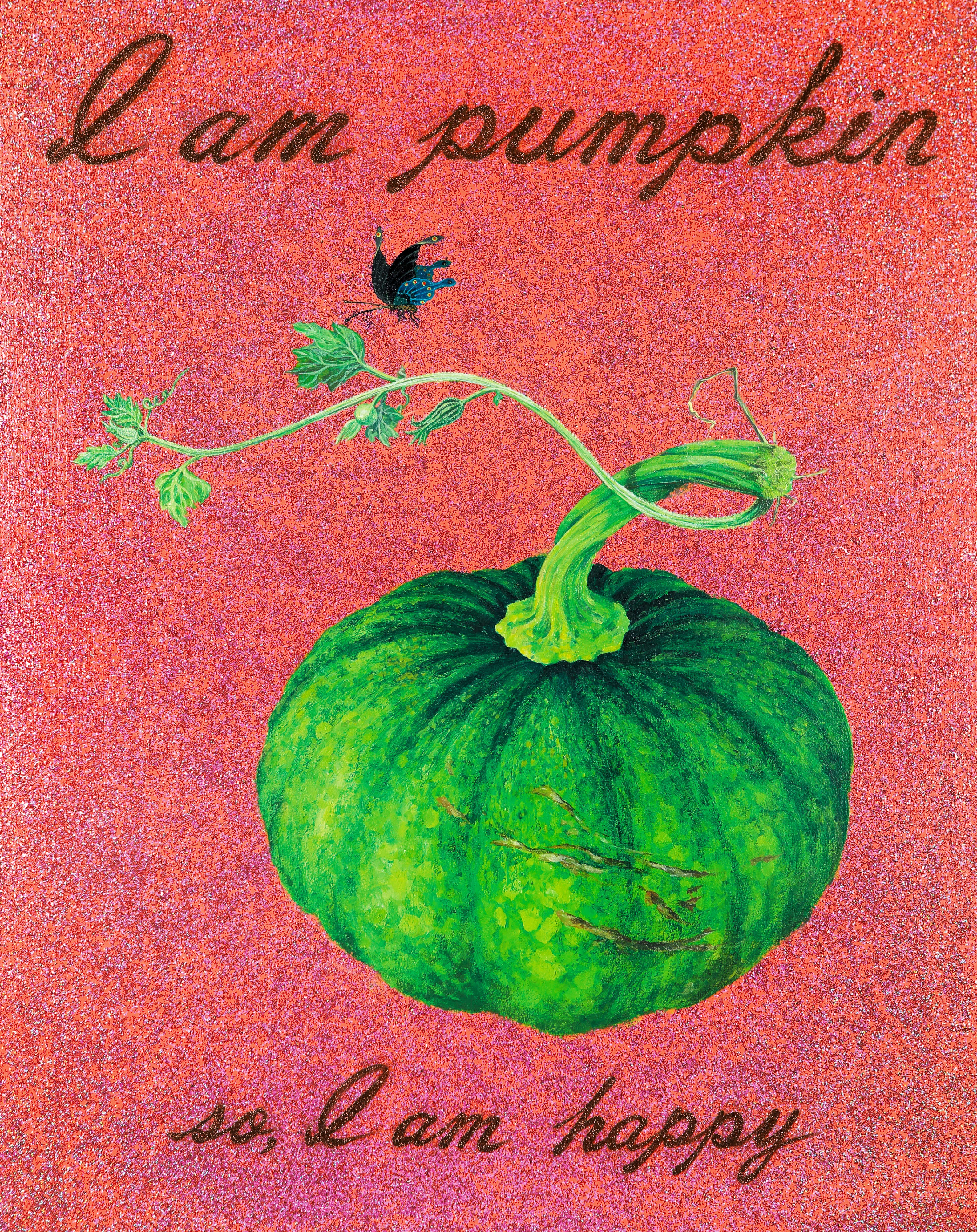
나는 호박인 내가 좋다. 나는 사과인 자신이 자랑스럽다. 나는 내가 바나나라서 행복하다. 비록 구멍이 숭숭하지만, 나는 깻잎인 자신이 좋다. 더욱이 허공을 가르며 날아오를 때 나는 행복하다. 이처럼 작가의 그림에서는 깻잎도 날고, 바나나도 날고, 멸치도 날고, 포도알도 날고, 브로콜리도 날고, 메추리알도 날고, 계란후라이도 날고, 배추도 하늘을 날아다닌다. 나비도 날고, 이름 모를 새들도 날고, 봉황과 같은 신화 속 새도 날고, 먹구름으로 변신한 용도 하늘을 날아다닌다. 열기구도 날고, 유에프오도 날고, 스파이더맨도 날고, 마징가 제트도 날고, 아톰도 하늘로 날아오른다. 여기에 바나나도, 배추도, 메추리알도, 그리고 계란후라이도 날기 위한 날개가 있어서 언제든 날아오를 수 있다. 심지어 날개 달린 메추리알에서는 표정을 읽을 수도 있다. 이처럼 작가의 그림에서는 마음만 먹으면 무엇이든 하늘을 날아오를 수도 날아 올릴 수도 있을 것 같다. 여기에 배마저도 물속인 양 하늘을 노 저어 간다. 아마도 일엽편주로 상징되는 고독한 존재를 의미할 것이다. 배가 떠가는 칠흑 같은 배경을 우주로 본다면, 망망대해의 우주를 저 홀로 떠도는 미아 같은 존재를 의미할 것이다.
무슨 일이 일어나고 있는가. 사물 인격체인가. 사물에 격이 있다면 모를까, 인간이 아닌 만큼, 사물 스스로 인격을 가지고 있을 리가 없다. 그러므로 작가가 사물에 자신을 투사한 것으로 보인다. 사물에 자신의 인격을 투사하고, 욕망을 투사하고, 상상을 투사하고, 꿈을 투사한 것으로 보인다. 그런 만큼 자신을 분기한, 그러므로 자신의 일부를 사물에 내어준, 그래서 어느 정도 자기 자신이기도 한, 자기 분신이며, 자기_타자이며, 얼터에고로 보인다. 화법으로 치자면 사물에 빗대어 자기를 이야기하고, 인간을 이야기하고, 삶을 이야기하고, 존재를 이야기하는 은유와 우화적 표현으로 읽힌다. 이 모든 일은 식탁 위에서 일어난 일이다. 작가에게 식탁은 이미지가 생산되는 공장이다. 세계의 중심이며 우주다. 현실과는 또 다른 삶의 현실이 생성되는 장이다. 삶이 공연되는 무대이며, 꿈이 현실이 되는, 그러므로 무의식적 욕망이 상연되는 극장이다. 꿈의 무대라고 해도 좋고, 욕망극장이라고 해도 좋다. 그 극장에는 심지어 무대 가장자리에 중후한 커튼마저 열려 있어서 사람들을 관객으로 초대한다. 사람들에게 무대 위에서 일어나는 현실에 참여를 유도해 공감을 얻는, 그림 속 현실을 그림 바깥의 현실로까지 확장하는, 그렇게 현실과 현실 인식을 확장하는 회화적 혹은 미학적 장치라고 보면 되겠다.
그렇다면 이 도저한 상상력(혹은 현실 인식)은 어디서 어떻게 온 걸일까. 아마도 식탁을 중심으로 이루어지는 가사노동을 반영할 것이다. 그리고 여기에 대중문화 아이콘을 빌린 장난감을 매개로 한 육아 경험을 반영하고 있을 것이다. 지금은 시대가 변해 꼭 그렇지도 않지만, 그래도 가사노동과 육아 경험은 전통적으로 여성 주체의 성적 정체성을 반영하고, 생활감정을 반영한다. 그리고 여기에 기법적인 면에서도 한 땀 한 땀 정성스레 수 놓은 자수를 연상시키는, 그 실체가 손에 잡힐 듯 생생한, 세부가 오롯한 세밀화를 떠올리게 만드는, 생활예술을 떠올리게 만드는 감수성과 감각을 반영하고 있다는 점에서 작가의 작업은 어느 정도 여성주의와 관련되는 부분이 있다. 정치한 묘사와 함께 세부가 살아있는 그림인 만큼, 무슨 숨은그림찾기라도 하듯 이런저런 상징을 그림 속에 숨겨놓고 있는데, 존재론적 외상을 예술로 승화한 프리다 칼로를 떠올리게 하는 부분도 있다. 특히 여전히 꽃을 피우는 새까맣게 불에 탄 나무가, 금이 간 기둥으로 세상을 떠받치고 있는 프리다 칼로의 척추를 떠올리게 하는 그림이 그렇다. 이처럼 작가의 그림에서는 현실 참여를 통해 자기를 실현하기보다는 여성성의 발현을 통해 자기를 실현하는, 그리고 여기에 생명 사상과 함께, 사람과 자연을 넘어 사물을 아우르는 사해동포주의가 생태 여성주의를 떠올리게 하는 부분이 있다.
상상력 자체에 대해서 말하자면, 상징주의와 낭만주의의 사제로도 알려진 보들레르는 상상력이 예술에서 결정적이라고 했다. 지금 여기가 아닌 다른 곳을 꿈꾸게 만드는 도구란 점에서 어느 정도 유토피아와도 통하는 개념이다. 그리고 여기에 플라뇌르(도시의 산책자, 작가의 경우에는 식탁 위의 산책자)와도, 소요유(칸트의 무목적적 합목적성의 개념과도 통하는)와도, 의식의 유목(질 들뢰즈)과도 통하는 개념이다. 작가의 그림 역시 지금 여기가 아닌, 다른 곳을 꿈꾸게 만든다. 그림을 매개로 한 꿈(그 자체 상상력의 다른 이름인)을 통해 유년의 추억을 불러오고, 그 추억이 자기를 실현할 다른 세상을 꿈꾼다.
이를테면, 작가는 어머니의 계란후라이의 추억으로부터 계란꽃을 상상하고, 계란섬을 상상하고, 계란과일을 상상한다. 계란후라이가 꽃을 대신하고, 섬을 대신하고, 과일을 대신하고, 세상의 모든 풍경을 대신한다. 심지어 계란후라이는 추억하기 위한 사진이라도 되는 양, 하늘이 무슨 보이지 않는 벽이라도 되는 양 리본(아마도 추억하고 기념한다는 의미가 있을)에 매달려 허공에 떠 있기조차 하다. 그리고 아버지는 사랑한다는 말을 고맙다는 말로 대신했다. 그래서 작가는 깡마르고 뒤틀어진, 아버지의 사랑처럼 투박하면서 따뜻한 체취가 느껴지는 나뭇가지를 엮어 사랑한다는 글꼴의 탑을 세웠다. 어머니를 추억하고 아버지를 오마주한 것인데, 이런 추억과 오마주가 작가의 그림 도처에 숨어있다. 이를테면, 기울어진 물 주전자로부터, 보이거나 보이지 않는 손으로부터, 때로 풍경 속 폭포를 대신하기도 하는, 물줄기가 쏟아져 내리는데, 어머니와 아버지의 보이지 않는 손길을 의미할 것이다. 그리고 대를 이어 그 자신 어머니가 된 작가의 가족과 타자를 향한 보살핌과 염려를 의미하기도 할 것이다.
그리고 상상력은, 특히 작가의 경우에서처럼 꿈과 매개된 상상력은 초현실주의에 대한 공감으로부터 온다. 그림과 텍스트, 이미지 텍스트와 문자 텍스트가 하나의 화면에 공존하는 그림이 한눈에도 르네 마그리트를 연상시키는데, 마그리트의 그림에서 문자와 그림이, 개념과 실재가 충돌한다면, 작가의 그림에서는 전통적인 그림책에서처럼 문자와 그림이 상호보충적 의미기능을 하는 것이 다른 점이다. 여기에 초현실주의로부터 온 결정적인 영향으로 치자면 데페이즈망 그러므로 사물의 전치를, 그리고 눈속임 회화기법을 들 수가 있을 것이다. 전형적인 시공간 개념을 해체해 재구성하는 것을 의미하고, 임의적이고 자의적인 탈주선을 따라 욕망이 자기를 실현하도록 억압된 욕망을 풀어주는 것을 의미하고, 감각적 현실을 참조할 뿐, 감각적 현실과는 다른 회화적 현실을 여는 것을 의미하고, 있을 법하지 않은 현실을 손에 잡히는 현실처럼 제안하는 것을 의미하고, 궁극적으로 세계를 재편하는 것을 말한다. 의식이 곧 세계인 만큼 의식을 재편하고 확장하는 것을 의미하는데, 그 의미가 후기구조주의의 탈맥락과 재맥락과도 통한다. 후기구조주의에 의하면, 그 자체 결정적인 의미가 있는 것이 아니라, 맥락이 의미를 낳고 결정한다. 맥락이 달라지면 의미 또한 달라진다. 그런 만큼 맥락이 의미의 집이다. 결국 그림이란, 이미지란, 예술이란 탈맥락과 재맥락의 실천을 통해 은폐된 세상(숨은 의미)을 캐내고, 또 다른 세상을 여는(또 다른 의미를 얻는) 일이다.
거칠게 말해, 그림에는 두 부류가 있다. 보는 그림과 읽는 그림이 그것이다. 그중 작가의 그림은 읽는 그림 쪽에 가까운데, 예술은 이야기하는 기술이라는 정의와 관련이 깊다. 비록 사사로운 이야기 그러므로 개인사에 바탕을 둔 그림이지만, 사적 경험치를 넘어 보편성을 얻고 공감을 얻는 그림이다. 전통으로 치자면, 문인 사대부의 계급 이데올로기를 반영한 관념산수(그러므로 감상을 위한 그림)보다는 이름도 없는 무명 화가들이 그린, 민중의 생활감정을 반영하고 있는 민화(그러므로 일종의 이야기 그림)와 관련이 깊다. 그림 속에 이런저런 상징으로 숨겨져 있는, 속 깊은 이야기들이 한을 얻고, 해학을 얻고, 풍자를 얻는 것이 그렇다. 상식을 깨는 파격이 그렇고, 예기치 못한 조합으로 억압된 욕망이 자기를 실현하도록 돕는 것이 그렇고, 이로써 의외의 현실(그 자체 작가가 생각하는 이상세계와도 무관하지 않을)을 여는 것이 그렇다. 그렇게 작가의 그림에서는 전통적인 그림에서 유래한 아이콘들, 이를테면 화조화와 초충도, 민화와 문자도, 괴석과 괴목, 그리고 여기에 전통 자수에 반영된 심미적 DNA를 계승하고, 차용하고, 자기화한 부분이 있다. 그렇게 자기만의 세상을 짓고, 세계를 여는 부분이 있다.
English
Dreams on the Dining Table, Building Worlds, Opening Worlds
Kho Chunghwan (Art Critic)
I like being a pumpkin. I am proud to be an apple. I am happy to be a banana. Even with holes, I like being a perilla leaf. Moreover, I am happy when I soar through the air. In the artist's paintings, perilla leaves fly, bananas fly, anchovies fly, grapes fly, broccoli flies, quail eggs fly, fried eggs fly, and cabbages fly through the sky. Butterflies fly, nameless birds fly, mythical birds like phoenixes fly, and dragons transformed into dark clouds fly through the sky. Hot air balloons fly, UFOs fly, Spider-Man flies, Mazinger Z flies, and Astro Boy soars into the sky. Here, bananas, cabbages, quail eggs, and even fried eggs have wings, so they can take flight at any time. One can even read expressions on winged quail eggs. In the artist's paintings, it seems anything can fly or be made to fly if one wishes. Even boats row through the sky as if it were water. This likely symbolizes a solitary existence, represented by a single leaf boat. If the pitch-black background where the boat floats is seen as space, it would signify a lost being adrift alone in the vast ocean of the cosmos.
What is happening? Are these objects personified? Unless objects have a certain status, they cannot possess personalities as they are not human. Therefore, it appears the artist projects herself onto the objects. She projects her personality, desires, imagination, and dreams onto them. As such, they are extensions of herself, parts of herself given to the objects, and thus, to some extent, her own self, her alter ego, her self-other. In terms of rhetoric, it reads as metaphor and allegorical expression, where she speaks of herself, humanity, life, and existence through the analogy of objects. All of this takes place on the dining table. For the artist, the dining table is a factory where images are produced. It is the center of the world and the cosmos. It is a space where a reality of life, distinct from actual reality, is generated. It is a stage where life is performed, a theater where dreams become reality, where unconscious desires are enacted. It can be called a dream stage or a theater of desire. In this theater, even a grand curtain is drawn at the edge of the stage, inviting people as spectators. It is a painterly or aesthetic device that encourages people to participate in the reality unfolding on stage to gain empathy, extending the reality within the painting to the reality outside the painting, thereby expanding reality and the perception of reality.
So, where and how did this profound imagination (or perception of reality) come from? It probably reflects the domestic labor centered around the dining table. And it likely reflects childcare experiences mediated by toys borrowing pop culture icons. Although times have changed and this is not always the case, domestic labor and childcare experiences traditionally reflect the sexual identity of female subjects and their everyday emotions. Furthermore, the artist's work has a certain connection to feminism in that it reflects a sensibility and sense reminiscent of meticulous embroidery, so vivid it feels tangible, evoking detailed miniatures with every detail intact, and reminding one of domestic arts. As the painting is full of intricate depictions and lively details, various symbols are hidden within it, as if in a hidden picture puzzle, and there are aspects that recall Frida Kahlo, who sublimated ontological trauma into art. This is especially true of the painting where a charred tree still blossoms, reminiscent of Frida Kahlo's spine supporting the world with a cracked column. In this way, the artist's paintings realize the self through the manifestation of femininity rather than through participation in reality, and here, along with the philosophy of life, there is an aspect of cosmopolitanism encompassing objects beyond people and nature, which evokes eco-feminism.
Regarding imagination itself, Baudelaire, also known as a priest of symbolism and romanticism, stated that imagination is crucial in art. It is a concept somewhat akin to utopia in that it is a tool that makes one dream of a place other than the here and now. And it also connects with the flâneur (the urban wanderer, or in the artist's case, the dining table wanderer), with soyo-yu (a concept related to Kant's purposiveness without purpose), and with the nomadism of consciousness (Gilles Deleuze). The artist's paintings also make one dream of a place other than the here and now. Through dreams mediated by painting (which is another name for imagination itself), childhood memories are evoked, and those memories dream of another world where the self can be realized.
For example, the artist imagines egg flowers, egg islands, and egg fruits from the memory of her mother's fried eggs. Fried eggs replace flowers, islands, fruits, and all the landscapes of the world. The fried eggs even hang in the air, suspended by ribbons (perhaps signifying remembrance and commemoration), as if they were photographs for memory, and the sky were some invisible wall. And her father replaced words of love with words of gratitude. So the artist wove together thin, twisted branches, rugged and warm like her father's love, to build a tower in the shape of the word 'love'. This is a remembrance of her mother and an homage to her father, and such memories and homages are hidden throughout the artist's paintings. For instance, from a tilted watering can, from visible or invisible hands, sometimes replacing waterfalls in a landscape, streams of water pour down, which would signify the invisible touch of her mother and father. And it would also signify the care and concern for her family and others, as the artist herself became a mother, continuing the lineage.
And imagination, especially imagination mediated by dreams as in the artist's case, comes from an empathy for surrealism. Paintings where images and texts, image texts and written texts coexist on a single screen immediately bring to mind René Magritte, but while in Magritte's paintings, words and images, concepts and reality clash, in the artist's paintings, words and images perform complementary semantic functions, as in traditional picture books, which is a difference. Here, the decisive influences from surrealism would be dépaysement, meaning the displacement of objects, and trompe l'oeil painting techniques. This means deconstructing and reconstructing typical spatiotemporal concepts, releasing repressed desires to realize themselves along arbitrary and willful lines of flight, referring only to sensory reality but opening up a painterly reality different from sensory reality, proposing improbable realities as tangible realities, and ultimately reorganizing the world. As consciousness is the world, it means reorganizing and expanding consciousness, and its meaning also connects with post-structuralist decontextualization and recontextualization. According to post-structuralism, meaning is not inherent but is born and determined by context. If the context changes, the meaning also changes. As such, context is the home of meaning. Ultimately, painting, images, and art are about excavating hidden worlds (hidden meanings) and opening up other worlds (gaining other meanings) through the practice of decontextualization and recontextualization.
Roughly speaking, there are two categories of paintings: those to be seen and those to be read. The artist's paintings lean towards the latter, deeply related to the definition of art as the art of storytelling. Although they are private stories, based on personal history, they are paintings that transcend private experience to gain universality and empathy. In terms of tradition, they are more closely related to minhwa (folk paintings, a type of narrative painting) that reflect the everyday emotions of the common people, painted by nameless artists, rather than the idealized landscapes (paintings for appreciation) that reflected the class ideology of literati-officials. This is evident in the deep stories hidden as various symbols within the paintings, which gain han (a deep sense of sorrow), humor, and satire. This is true of the unconventional breaking of common sense, of helping repressed desires realize themselves through unexpected combinations, and thereby opening up an unexpected reality (which is not unrelated to the ideal world the artist envisions). In this way, the artist's paintings inherit, borrow, and internalize aesthetic DNA reflected in traditional icons such as flower-and-bird paintings, insect-and-grass paintings, minhwa, 문자도 (character paintings), grotesque rocks and trees, and traditional embroidery. In doing so, she builds her own world and opens up new worlds.