Kim Nam-yoon (Chief Curator, Ami Art Museum): Untransparent Times - A Journey Frozen in Kairos Time
2026-06-08
지오 최는 오늘도 여행 중이다. 장시간 작업실에 들어앉아 눈과 마음에 담긴 것을 곱씹어 보고, 화면에 펼쳐내는 내면의 여행이다. 그런데 이는 선형적으로 흐르는 크로노스(Chronos)의 시간이 아닌, 기억과 감정이 겹겹이 포개져 ‘불투명한 시간’ 속에서 펼쳐진다. 지오 최의 작업은 본질적으로 층층이 쌓인 기억 속 카이로스(Kairos)의 시간에서도 빛을 잃지 않고 선명히 떠오르는 대상을 건져내어 시각화하는 과정이기 때문이다.
물론 실제 물리적인 여행도 잦은 편이라 이번 전시에서 선보이는 작품들 역시 작년 미국 네바다와 유타 10여 곳의 국립공원 레지던시를 비롯해 캐나다, 제주도, 거제도, 최근 중국 산서성에 이르는 장소의 특성을 고스란히 드러낸다.
그렇다고 지오 최가 의도적으로 ‘그럴싸한 멋진 풍경’을 찾아다니는 것만은 아니다. 예술가의 눈과 손은 오히려 일상의 평범한 것도 색다르게 보이게 하지 않는가. 그리하여 여행의 대상에는 수년간 마당을 지키고 있는 새하얀 목수국을 비롯해 이름 모를 풀과 곤충, 어머니가 해주셨던 계란후라이의 추억부터 지금도 종종 찍어 보내주시는 꽃사진, 마트에 진열된 싱그러운 샤인머스킷도 포함된다. 또 여기에는 매화철마다 찾아가는 하동이나 울산바위가 보이는 고성 등 정기적인 방문 장소도 그러하다.
중요한 것은 익숙한 풍경이나 색다른 경관 모두 장소에 대한 애정이 남다른 지오 최의 발길을 멈추게 한다는 점이다. 토포필리아(Topophilia)의 ‘이동 중 정지(pause in movement)’가 일어나는 순간이다. 이때 카이로스의 시간은 더 이상 흐르지 않고 머무르며 깊어진다. 여기에 시각 외에 청각과 후각의 감촉까지 스며들고, 작은 사건들까지 켜켜이 포개지면 대상에는 더욱 독특한 느낌과 정서가 덧입혀진다. 평범해 보일지라도 내면에 깊이 각인되는 가치 있는 장소로 탈바꿈하는 것이다. 이는 작가가 굳이 브라이스 캐년(Bryce Canyon)을 반복적으로 찾아가는 이유를 설명해 주는 것이기도 하다.
한지에 그린 <동트는 브라이스 캐년>과 캔버스에 그린 <한밤의 환상곡>은 한 장소를 유사한 구도로 그리고 있지만 분위기와 정서에서는 확연한 차이가 난다. 물론 사용한 재료와 시간대부터가 다르기 때문이기도 하지만, 그곳이 반복된 방문과 관찰, 해석을 통해 의미가 축적된 장소, 곧 시간의 층위가 쌓인 공간으로 변모했음을 보여준다.
<동트는 브라이스 캐년>이 현장에서 마주한 찬란하고 장엄한 아침의 분위기를 여실히 담아내고 있다면, <한밤의 환상곡>은 브라이스 캐년의 밤 풍경에서 받은 인상과 감동을 작업실에서 곱씹어 풀어낸 것이다. 마치 군중처럼 표현된 후두(hoodoo)는 오랜 시간을 견뎌온 바위 안에 응축된 생명력을 표출하고자 불꽃이 피어오르는 모습으로 표현되었다. 하늘로 리드미컬하게 올라가는 불꽃이 은하수와 함께 환상적인 분위기를 더욱 고조시키며 마치 한 편의 환상곡(fantasy)을 연주하는 듯하다. 전자가 흘러가는 시간 속에서 잠시 숨을 고르며 담아낸 장면이라면, 후자는 좀 더 숙성된 카이로스의 시간에서 길어 올리고, 덧붙이며, 재조합한 사의적 풍경이라 하겠다.
사실 지오 최는 대상을 스케치하는 단계, 즉 현실의 시간에서는 처음부터 관념적으로 바라보는 것을 경계하고자 오히려 날 선 시선으로 대상에 대한 치열한 관찰을 시도한다. 그러나 작업실에서 이것이 담긴 스케치북을 펼치면서 또 다른 여행이 시작된다. 바위 하나하나의 시선으로 자연이 보이는 물아일체의 경험을 토대로 작가의 자유로운 상상력을 덧입혀 자연의 강인한 생명력과 신비를 드러내는 것이다.
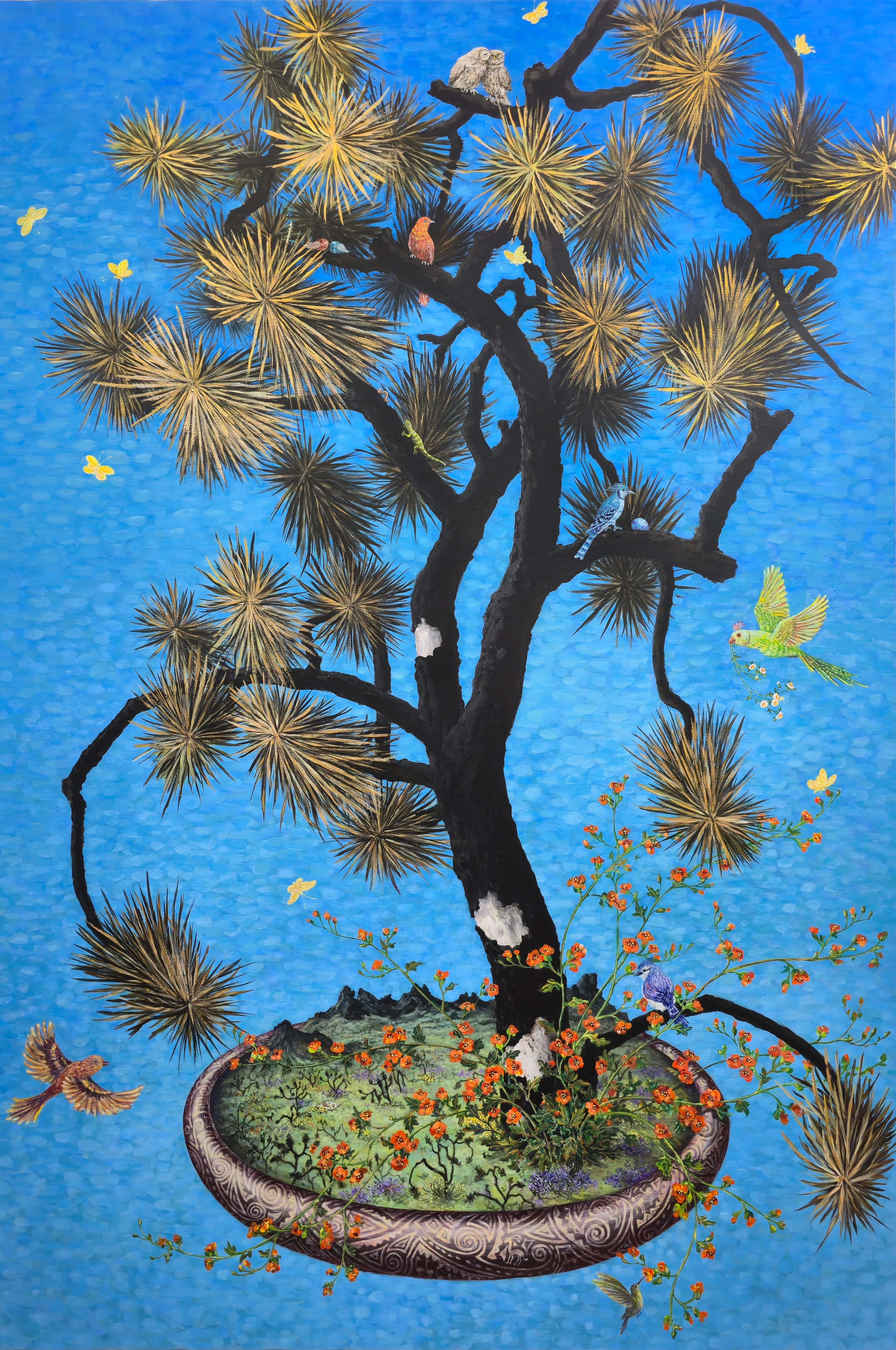
조슈아(joshua) 트리 역시 이러한 작업이 형태 너머의 감각에서 비롯되었음을 보여준다. 두 팔을 벌려 기도하는 여호수아(예수)의 모습을 닮은 조슈아 트리는, 척박한 사막에서 불에 탔음에도 여전히 꼿꼿하게 서 있는 모습으로 작가에게 깊은 인상을 남겼다. 이에 그저 죽은 나무에 불과할지라도 작품에서만큼은 자존감 있는 주인공으로 재탄생될 수 있었다. 또 매년 봄이면 반가이 맞아주는 하동 매화도 이번에는 성숙한 여인의 모습으로 거듭났다. 크로노스와 카이로스의 시간 속에서 늘 변화하는 예술가의 심상이 온전히 반영된 것이다.
이처럼 지오 최는 크로노스의 시간 속을 여행하지만, 그 여정의 정점은 언제나 카이로스의 순간에 있다. 결국 사실과 사의의 사이에 존재하는 수많은 결들이 그 간극을 불투명하게 만들지만, 지오 최의 작업은 바로 그 미묘한 틈을 가로지르며 태어나는 것이다. 투명하지 않은 시간이지만 감정의 필터를 통과한 대상은 시간 속 감정과 상상이 중첩된 세계에서 빛을 받아 탄생한다.
우리의 정신은 대상 앞에 멈춰 설 때, 시공간을 넘어 자유롭게 여행한다.
지금은 지오 최의 작품 앞에서 멈추어 카이로스의 여행을 떠날 시간이다.
English
Jioh Choi is on a journey today. It's an inner journey, where she sits in her studio for long hours, contemplating what she has seen and felt, and then unfolding it onto the canvas. This journey, however, does not flow in the linear time of Chronos, but rather unfolds within 'opaque time,' where memories and emotions are layered one upon another. This is because Jioh Choi's work is essentially a process of retrieving and visualizing subjects that emerge vividly, without losing their light, from the layered memories within Kairos's time.
Of course, she also travels physically quite often, and the works presented in this exhibition vividly reveal the characteristics of places visited last year, including residencies in over 10 national parks in Nevada and Utah, as well as Canada, Jeju Island, Geoje Island, and recently Shanxi Province in China.
However, Jioh Choi does not intentionally seek out 'plausible and wonderful landscapes.' Doesn't the artist's eye and hand make even the ordinary things of daily life appear extraordinary? Thus, the subjects of her travels include the pristine white hydrangeas that have graced her garden for years, nameless weeds and insects, memories of fried eggs her mother used to make, flower photos she still occasionally sends, and the fresh Shine Muscat grapes displayed in the supermarket. It also includes regularly visited places like Hadong during plum blossom season or Goseong, where Ulsan Rock is visible.
What is important is that both familiar scenes and unique landscapes cause Jioh Choi, who has an extraordinary affection for places, to pause. It is the moment when 'pause in movement' of topophilia occurs. At this point, Kairos's time no longer flows but lingers and deepens. When the sensations of hearing and smell, in addition to sight, permeate, and small events are layered, the subject is imbued with an even more unique feeling and emotion. It transforms into a valuable place deeply imprinted within, even if it appears ordinary. This also explains why the artist repeatedly visits Bryce Canyon.
<Bryce Canyon at Dawn> drawn on hanji and <Nocturne Fantasy> drawn on canvas depict the same location with similar compositions, yet they show distinct differences in atmosphere and emotion. While this is partly due to the different materials and times of day used, it also demonstrates how the place has transformed into a site where meaning has accumulated through repeated visits, observation, and interpretation—a space where layers of time have built up.
If <Bryce Canyon at Dawn> vividly captures the brilliant and majestic morning atmosphere encountered on-site, <Nocturne Fantasy> is a work that reinterprets the impressions and emotions from Bryce Canyon's nightscape in the studio. The hoodoos, depicted almost like a crowd, are expressed as rising flames to convey the condensed vitality within the rocks that have endured for a long time. The flames rhythmically ascending into the sky, along with the Milky Way, further heighten the fantastical atmosphere, as if performing a fantasy. If the former is a scene captured during a brief pause in the flow of time, the latter is a subjective landscape drawn, added to, and reassembled from a more matured Kairos time.
In fact, in the sketching stage, that is, in real time, Jioh Choi attempts an intense observation of the subject with a sharp gaze, precisely to guard against viewing it conceptually from the outset. However, when she opens the sketchbook containing these observations in her studio, another journey begins. Based on the experience of oneness with nature, where nature is seen through the eyes of each rock, the artist's free imagination is added to reveal the strong vitality and mystery of nature.
The Joshua tree also demonstrates that this work originates from a sense beyond form. The Joshua tree, resembling Joshua (Jesus) praying with outstretched arms, left a deep impression on the artist with its upright stance despite being burned in the harsh desert. Consequently, even though it was merely a dead tree, it could be reborn as a protagonist with self-esteem in the artwork. Similarly, the Hadong plum blossoms, which she joyfully greets every spring, have now transformed into the image of a mature woman. This fully reflects the artist's ever-changing psyche within the times of Chronos and Kairos.
In this way, Jioh Choi travels through the time of Chronos, but the climax of her journey is always in the moment of Kairos. Ultimately, the countless nuances existing between fact and interpretation make that gap opaque, but Jioh Choi's work is born precisely by traversing that subtle space. Though time is not transparent, subjects filtered through emotion are born from a world where emotions and imagination are superimposed within time, receiving light.
Our minds, when paused before a subject, travel freely beyond space and time.
Now is the time to pause before Jioh Choi's work and embark on a Kairos journey.